Cancer Picked The Wrong Woman: A Recognition of Excellence on International’s Womans Day
When I was in high school and finally able to choose a few elective classes, I excitedly signed up for creative writing, speech, art history, and yes, with more enthusiam than any teenager should have, Shakespeare.
I loved all of my classes, but especially my creative writing teacher. He had an unconventional way of teaching. One day he had us sit quietly while Pink Floyd played through the classroom speakers and simply told us to write what we heard. Not what the lyrics said, what we heard. What the music meant to us.
But the thing he said that stayed with me the longest was this:
Every story ever written has the same plot. Things are not what they seem.
And so here I am years later, a writer by leisure and not profession. Yet it was the echo of those words about plot that always stayed with me.
Things are not what they seem.
I have learned that lesson many times in life—through love, through careers, through friendships and family and the hard decisions that life demands of you. But never more so than when my mom was diagnosed with a rare type of uterine cancer.
Cancer sucks.
Yes, it absolutely does.
And like most people, I thought I understood cancer.
It was a terrible disease of abnormal cell growth. But it could be treated with chemotherapy, hope, and prayer.
But when it arrived in our lives, I realized how little I actually knew.
I became a rogue student of cancer and its treatment, trying to understand a disease I had heard about a million times. But I also knew, from years of dealing with chronic pain and navigating doctors, that the labyrinth of healthcare, especially cancer, was a maze I was not fully prepared to enter.
The first question that consumed me was simple.
How could my mom have cancer?
At seventy-six she was absurdly healthy. She didn’t smoke or drink. She didn’t take prescription medications. She walked three to five miles every day and worked full time. She probably would have been diagnosed with ADHD in today’s world because she simply never sat still. If you left her alone with nothing to do, she would probably start decorating the nearest cul-de-sac.
So when the diagnosis came around Thanksgiving, it was jarring.
But being my mom, she approached it the only way she knew how; with determination. She was resolved to beat it and continue living life because, in her words,
“I have things to do.”
The scans told a more complicated story. The cancer had consumed her uterus and nearby lymph nodes. Even more troubling, the scans revealed innumerable nodules scattered throughout both lungs, highly suspicious for metastasis. Fifteen pages of genomic and germline testing later, the recommended plan emerged: chemotherapy combined with immunotherapy.
Mom agreed, and her cancer journey moved to the next chapter.
But this is where I paused; where the questions began to roll around in my head like marbles with nowhere to go.
If the hysterectomy had removed the cancer,with the lungs still indeterminate. why did she need chemotherapy?
“It’s preventive,” the doctor explained. “In case cancer cells are hiding somewhere.”
Her survival rates were explained in numbers.
Two to five years with treatment.
Six to twelve months without.
The treatment might increase her life expectancy by roughly 1.5 years.
Chemotherapy at her age can be fatal in up to 25 percent of patients. Severe toxicity occurs in nearly half of patients her age, and of those, about 30 percent may not survive the reaction.
These numbers circled quietly in the back of my mind as my mom began her treatment. I held onto the hope—perhaps naively—that my mom would not become one of those statistics.
What worried me most was that she was beginning this journey 1,200 miles away from me, with no immediate family nearby.
But she reassured me.
“She’d be fine.”
She had friends who had volunteered to help if needed.
Still, that day something shifted inside me. For the first time in my life, I felt, just briefly, like the parent to my own mother. She added me to her bank account, provided passwords and important information “just in case.”
Her chemotherapy was administered without complication. She reported no issues afterward, even remarking how fortunate she felt as she watched younger and far sicker patients receiving treatment at the center alongside her. That was always her mindset in life. Grateful. Gracious. Always aware of how fortunate she was. No matter how difficult things became, she believed it could always be worse.
The day after chemotherapy, she was fine.
The day after that, she felt a little tired and went home early from work. That was unusual for her, but understandable given the circumstances.
On the fourth day, I couldn’t reach her.
By the fifth day, I finally got through.
She was so weak. So tired. She had no idea it would hit her this hard. But she reassured me that her friend was with her if she needed anything.
A few more days passed. She mentioned how frail she felt but said she had her walker and her friend helping her get to the bathroom. She reminded me about her follow-up appointment the next day.
The next day she was sent immediately to the emergency room.
Grade 4 chemotherapy toxicity.
A fever of 103 degrees.
Severe dehydration.
She had lost fifteen pounds. She only weighed 130 to begin with.
And so began the foreign and terrifying process of watching chemotherapy gut my mother. While she remained cognitively aware and doctors reassured us that her major organs were functioning, her body had been devastated. She could not walk. She could not go to the bathroom without assistance. Even the effort holding up her head to eat exhausted her.
During visits to the hospital, I would occasionally see flashes of the woman I knew and her optimism, her tenacity, but they seemed dimmed, fragile. This was a battle she hadn’t prepared for. None of us had.
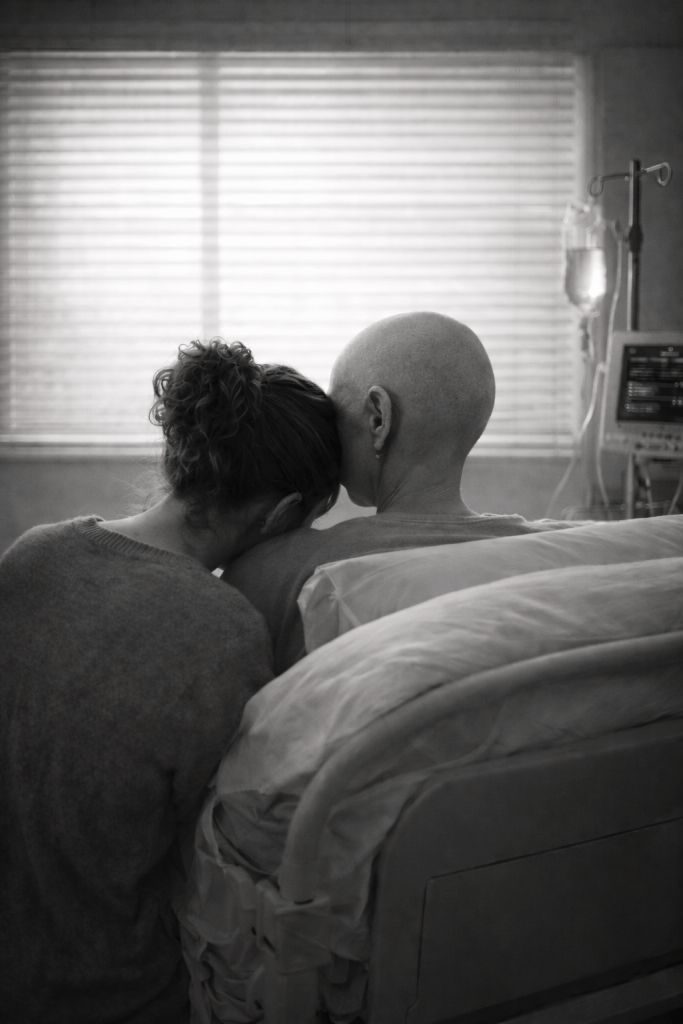
I suppose every child carries some quiet expectation of immortality when it comes to their parents. I had never truly imagined my mom not being here. Not until I saw her lying in that hospital bed. Her long red hair, the feature that had always defined her, was gone, replaced by a smooth porcelain scalp. Her high cheekbones, which had always framed her beauty, now made her look gaunt. Her busy mind, once always full of ideas and plans, had grown quieter. Sometimes she would drift off mid-sentence.
Eventually she was transferred to a rehabilitation facility.
And something remarkable began to happen.
She started fighting again.
She is still weak. Still frail. But after a week in rehab she can walk more than twenty steps with a walker. She can hold her head up and talk on the phone again. Her physical therapist gives her a goal and she immediately declares,
“I’ll beat that by ten.”
And in those moments I see it, the return of the woman who raised me. Her fight. Her independence. Her refusal to fail.
For now, she has chosen not to continue chemotherapy until she regains her strength. She is weighing quality of life versus quantity, and time will ultimately tell.
Somewhere in the quiet moments of this journey, faith enters the story as well. Because Scripture reminds us that our days are ultimately held in God’s hands. As Psalm 139 says, “All the days ordained for me were written in Your book before one of them came to be.”
We seek wisdom. We ask questions. We fight for the people we love. But in the end, we trust that God sees the whole story when we can only see a single chapter.
None of us know how long this chapter will last.
Maybe six months.
Maybe sixteen years.
But I do know this.
Cancer picked a fight with the wrong woman.
My mom has always been strong, relentless, compassionate, and stubborn in the best possible way. A woman who worked hard, loved deeply, and never stopped moving forward.
On International Women’s Day, I celebrate the strongest woman I know. A woman of faith. A woman of grit. A woman who refuses to surrender.
The world calls it resilience. I call it what my mother has always had—an unbreakable spirit.
Which brings me back to something my creative writing teacher once said all those years ago.
Every story ever written has the same plot.
Things are not what they seem.
Because cancer may have entered the story.
But it has not written the ending.
Happy International Women’s Day, Mom.
Your story is still being written. ❤️

