The existence of government itself implies a social contract. Citizens surrender certain freedoms not because liberty lacks value, but because ordered liberty requires structure, protection, and enforcement. The Founders understood this tension intimately. A society without law becomes chaos; a society without limits upon government becomes tyranny. The enduring challenge of constitutional governance has therefore never been whether authority should exist, but how authority can exist within principled boundaries.
This distinction becomes critically important in the modern debate surrounding surveillance technology. Opponents of automated license plate recognition systems often frame the issue as though any governmental observation constitutes an inherent violation of liberty. Yet such arguments frequently fail to distinguish between privacy in constitutionally protected spaces and observation occurring within the public sphere itself.
A motor vehicle traveling upon a taxpayer-funded public roadway occupies a uniquely regulated legal space. It requires licensure, registration, insurance, adherence to traffic ordinances, and the display of a government-issued identifier specifically designed for visibility and accountability. The expectation of privacy upon a public roadway has never mirrored the expectation of privacy within one’s home, personal papers, or private communications.
This legal principle has long been reflected in constitutional precedent. In Carroll v. United States, the United States Supreme Court recognized what became known as the “automobile exception,” acknowledging that the inherent mobility of vehicles creates circumstances distinct from fixed private property. The Court understood that mobility can frustrate lawful investigation if law enforcement is required to delay action until evidence disappears beyond reach. Modern technology does not eliminate this principle; rather, it expands the efficiency with which lawful identification may occur.
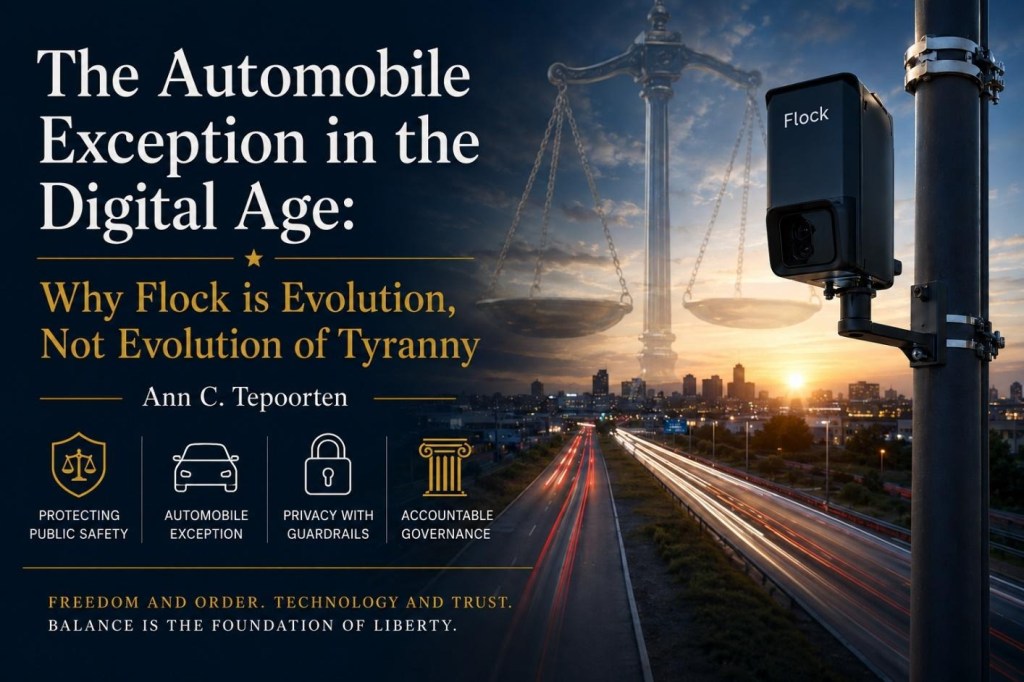
A Flock Safety camera does not magically create criminal conduct where none exists. It does not independently determine guilt, convict suspects, or replace judicial due process. At its core, technology merely captures what is already exposed to public view: a vehicle, its license plate, and its location upon a public roadway at a given moment in time.

In many ways, traffic cameras already serve as a basic form of what Flock Safety cameras do today. Society has largely accepted that activity taking place on public roads can be observed and recorded for public safety purposes. Red-light cameras, toll booths, speed cameras, parking enforcement systems, and highway monitoring all operate on the same basic idea: if you are driving on a public roadway, your vehicle and license plate are visible to the public.
The difference with Flock technology is not that it suddenly created surveillance; the difference is that it provides clearer and more reliable information. Instead of relying on vague eyewitness descriptions, guesses, or circumstantial suspicion, investigators can use objective evidence tied to a specific vehicle, time, and location. If someone believes traffic cameras are acceptable, but completely rejects Flock cameras, it becomes important to explain what the actual constitutional or practical difference is between the two. Both involve observing vehicles operating in public spaces where laws already require drivers to display identifiable license plates.
The constitutional question therefore is not whether observation occurs, but whether the collection, retention, access, and application of that information remain proportionate, accountable, and constrained by law. That distinction matters enormously.
Technology itself is morally neutral. The same technological advancement capable of locating an abducted child can also be abused without safeguards. The same information capable of helping law enforcement locate a fleeing homicide suspect could theoretically be misused for political targeting, personal retaliation, unauthorized monitoring, or unconstitutional overreach if left unchecked. History repeatedly demonstrates that government authority without oversight eventually invites abuse, regardless of political ideology or institutional intent.
Thus, the true constitutional debate surrounding Flock technology should not center upon absolutist positions of “all surveillance is tyranny” or “public safety justifies everything.” Neither position survives rigorous philosophical scrutiny. A free society demands something far more difficult: balance.
A Euclidean approach (a philosophy President Lincoln was fond of) to this debate requires disciplined reasoning rooted in first principles. If the government possesses a legitimate duty to protect the public, then it may reasonably employ lawful tools capable of assisting that mission. If constitutional liberties possess inherent value, then those same tools must remain carefully limited, transparent, reviewable, and accountable to the people. Both propositions can simultaneously be true.
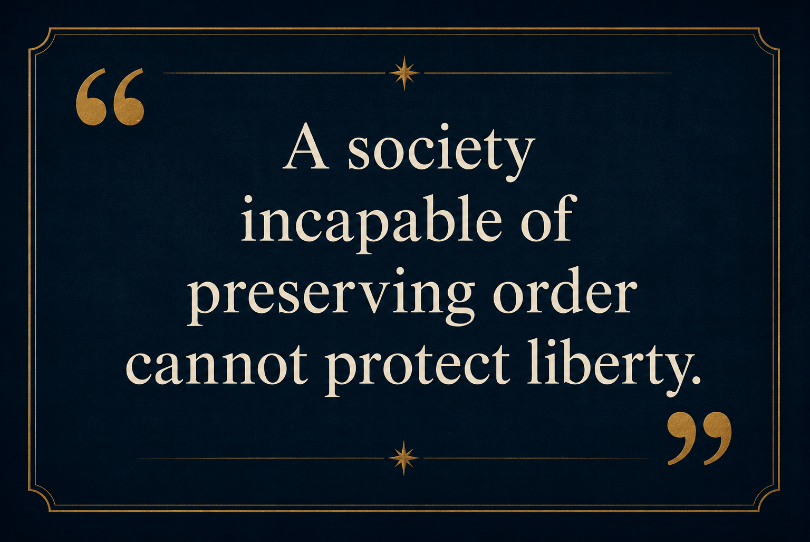
While Euclid provided the framework of disciplined reasoning, Marcus Aurelius offered a philosophy of disciplined governance. Aurelius understood that freedom and order were not opposing forces, but interdependent ones. A society incapable of preserving order cannot protect liberty; yet a government unconstrained by virtue and restraint eventually destroys the very freedoms it claims to defend.
Accordingly, any intellectually honest defense of Flock technology must also support meaningful safeguards, including:
- Strict data retention limits
- Comprehensive access logging and auditing
- Criminal penalties for misuse
- Prohibitions against unauthorized surveillance
- Judicial oversight where constitutionally required
- Public transparency reporting
- Clearly defined statutory limitations on deployment and data sharing
Without such safeguards, public trust erodes. And once public trust erodes, even beneficial technology becomes socially corrosive. That does not mean technology should exist without limits. The more advanced the technology becomes, the more important safeguards, accountability, and oversight become as well. But it is difficult to argue that all roadway camera systems are acceptable until they become effective enough to help locate abducted children, stolen vehicles, missing people, or violent offenders more quickly.
Critics must also confront another uncomfortable reality: communities routinely demand that law enforcement solve violent crime, recover stolen property, locate missing people, and intervene rapidly during emergencies. Such expectations require investigative tools. To demand public safety while simultaneously rejecting every emerging investigative technology creates its own contradiction. The question cannot simply be whether technology exists, but whether its use remains rationally constrained within the framework of ordered liberty.
The practical reality behind these philosophical debates is vivid. Discussions occurring in academia or online political forums often become detached from real-world crises. A disoriented elderly patient suffering from dementia, a child abducted during a domestic dispute, or a violent offender fleeing a crime scene are not anecdotal hyperbole to the families involved. In those moments, minutes matter. Investigative clarity matters. The rapid identification of a vehicle can mean the difference between recovery and tragedy.
This does not diminish the importance of civil liberties. Rather, it reinforces why constitutional societies must insist upon both public safety and restraint simultaneously. The genius of a constitutional society has never been the elimination of power; it has been the limitation of power through structure, accountability, and law. Perhaps that is where Euclid remains unexpectedly relevant today. His method reminds us that difficult societal questions cannot be responsibly answered through fear, outrage, slogans, or political tribalism alone. They must instead be examined through disciplined reasoning, precise definitions, internal consistency, and principled limitations.
It is also vital to recognize that modern public safety technology does not emerge in isolation from the broader digital world we willingly participate in every day. A detailed digital footprint already exists through IP addresses, cellphone location data, electronic banking transactions, tollway records, GPS systems, online purchases, and social media activity. Together, they form a tapestry of daily movement and interaction.
The real question is not whether the information exists. The question is who has access to it, under what circumstances, with what limitations, and under whose oversight. In a free society, that information should never become universally accessible, politically weaponized, or immune from constitutional restraint.
Liberty is not preserved by denying reality. It is preserved by confronting these challenges honestly and placing principled limits on power before power exceeds its rightful boundaries.


Leave a comment